More outdated beer literature from the share drive at work. Changing fashions ruled beer drinking in the 50s, 60s and 70s. First bottled pale ale challenged draught mild as the Nation's favourite drink. Then a few years later, everyone was drinking draught keg bitter, with as described so well yesterday - Watneys Red Barrel the best known brand.
.Lager was the drink of the 70s. The hot summer of 1976 provided a reason to try the beverage, but tastes were changing. In 1971 there was a backlash against the relentless spread of keg bitter and lager when CAMRA, the Campaign for Real Ale, formed. In the latter part of the seventies there was a resurgence of some traditional brews; real ale, though, still remained a minority taste.
.Mild was the working man's drink for the first half of the twentieth century. The only choice was between mild and stout; bitter was a luxury. In 1900 best bitter was almost unknown and in 1929 it was still only a tiny fraction total beer sales.
At the start of the sixties, mild was the dominant beer. Around 40% of the output of Bass Charrington, Britain's largest brewer, was mild. By 1967 this had fallen to 30%. Mild was losing favour, though it was the cheapest beer. It did have strongholds in the Midlands (notably M & B Mild), but the majority chose best bitter.
Best bitter on draught and its bottled equivalent, best pale ale, were the favourite beers of the 60s. Pale ale was sold as a premium beer; it was a popular luxury.
.Keg bitter is pasteurised to stop any fermentation. Carbon dioxide is added to give the beer sparkle. The pressure of carbon dioxide is used to draw the beer up from the cellar. So keg beer does not need a traditional long handled beer pump.
.The big brewers though, did not heavily promote keg bitter until the late 50s. The first brewer to use the term keg and to promote sales of keg beer was Flowers (later taken over by Whitbread). Many of the others followed suit and each launched their own brand of keg bitter: Worthington 'E', Whitbread Tankard, Ind Coope Double Diamond, Youngers Tartan and Courage Tavern.
Sales of keg beer increased steadily throughout the sixties. In 1960 it was 1% of the total beer market, by 1965 7% and by 1971 18%. Keg beer was most popular with the young. It was the natural choice for the new themed pubs and disco pubs of the 60s. Keg bitter was more expensive than traditional cask conditioned ales and was marketed as a premium brand.
There was a tendency for brewers to reduce the strength and original gravity (a measure of the proportion of ingredients, hops, barley etc to water) of cask beers. The keg beers were the best the brewery had to offer so there was no need to spend as much on the cask conditioned beers. Throughout the sixties people suspected that that beer was getting weaker; they were right.
By the latter part of the sixties, carbon dioxide was often added to cask beers as well; they were drawn up from the cellar under pressure in much the same way as keg beer. For the drinker at the bar, there was little to choose between them. The more discerning opted for keg.
.The rise of keg bitter in the sixties stopped a trend that had begun after the War of increasing sales of bottled beer. It even appeared that sales of bottled beer might overtake draught beer. Reasons for choosing it over traditional ales were consistency, brightness, a clean palette and sparkle. Keg bitter provided all these qualities at a cheaper price.
Canned beer was in its infancy in the late 50s. Ind Coopes Long Life was one of the first. The brewer picked up on concerns about the quality of cask ales and claimed Long Life was brewed for the can and never varied. Canned beer sales increased throughout the sixties, but did not become important until the seventies.
.Before the 60s, the supply of beer had been regional. There were a few exceptions with bottled Guinness, Bass and Worthington sold throughout the country. In the sixties other national names emerged, namely Double Diamond (bottled), Mackeson Stout (bottled) and draught and bottled Watneys Red Barrel. Watneys Red Barrel was making inroads into the free trade. Double Diamond, Bass Worthington and most notably Guinness, were becoming increasingly available as draught. The success of Guinness encouraged Watneys to compete with Colonel Murphy's Stout. After a test marketing campaign, they abandoned it and stocked draught Guinness in Watneys' houses instead.
By the end of the sixties, lager too was more popular. Draught Carlsberg was available at Watneys' pubs and Whitbread had linked up with Heineken. Sales of lager, though, did not become significant until the 70s.
.Strong ales were often sold in nip bottles (one third of a pint). The most famous was Tennant's Gold Label; it was in the Guinness Book of Records as the strongest beer on regular sale in the UK. Later it was brewed as Whitbread Gold Label. 70s advertisements told drinkers that it was "Strong as a double Scotch, less than half the price". It is still available today.
.At the beginning of the 70s, the most popular brands of keg bitter dominated British beer drinking. They were more expensive than cask bitters, so people must have liked the taste or bought the advertising.
Advertising of keg bitters made extravagant claims. Whitbread Tankard was supposed to help you excel, how, was not made clear. Beer had long been advertised as a drink to improve heath. The "Guinness is Good for You" and "Guinness for Strength" campaigns are famous. Was a touch of parody intended?
Rivals made equally bold claims. Worthington 'E' was "the taste that satisfies". Courage Tavern was "What your right arm's for". Double Diamond "worked wonders".
Keg bitter's popularity was challenged in the 70s by lager. Sales of lager increased from only 2% of the market in 1965 to 20% in 1975.
Lager had been sold in Britain long before the 60s. It was brewed here as early as the 1890s, but was a very small part of the beer market. It had a reputation as a ladies' drink. When mixed with lime it was considered as an alternative shandy.
Today's well known brands of lager were introduced in Britain from the 50s. The brewery magnate E P Taylor brought Carling Black Label to Britain, from Canada, in 1953. Starting from small beginnings, brewed under licence by the tiny Hope and Anchor Brewery, a series of mergers left Carling Black Label part of the Bass Charrington empire.
The other big brewers introduced their own brands. Guinness launched Harp Irish Lager in 1960. Whitbread signed an agreement to import Heineken in 1961; Watneys linked up with Carlsberg in 1968.
Whitbread brewed Heineken under licence in the UK in 1968. The Whitbread directors thought a weaker version of the Dutch beer would sell better - they were right. Later the Belgian beer, Stella Artois, joined the Whitbread stable as their premium lager.
It was the long hot summer of 1976 that firmly established Britain's taste for lager. Cool and refreshing, it was the beer to beat the drought. By the end of the decade, lager took 29% of beer sales.
There are many reasons for the rise in the popularity of lager. Package holidays in Europe gave people a chance to try lager and they associated it with relaxation and warmer climates. It goes better with more exotic food. Continental dishes - French and Italian - were popular in the 70s, as were Chinese and Indian food and there is no better accompaniment to a curry than a pint of lager.
.The aggressive promotion of keg bitters finally resulted in a backlash. CAMRA, the Campaign for Real Ale, was founded in 1971.
In the 70s, sales of cask beers began to rise as there was a growing appreciation for the traditional methods of brewing. It is a testament to the success of CAMRA that the "classic" keg bitters of the sixties are now extinct, however it is regrettable that modern brewing practices and innovation are largely ignored for the sake of tradition.
Labels: Beer


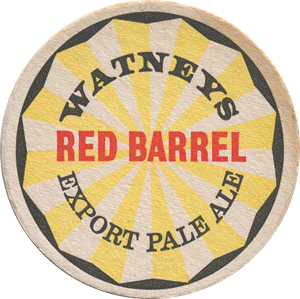 I have come across a fair bit of outdated beer literature on the share drive at work. Most of it is about keg bitter which probably won't interest the hardcore beer geeks, but may be of interest to the purists. I find the story of Watney's Red the most interesting, from all accounts it sounds like it was actually a decent beer.
 In the 1970's the marketing strategy made a shift. I find this change in direction fascinating, but then again I work in the business. Firstly, Watneys decided to change the name of Red Barrel to just Watneys Red. Advertising was based on the Russian Revolution. The billboard was displayed in London over the summer of 1971. Khrushchev, Mao and Castro all enjoying a pint of Watneys Red! (I find it Ironic that the key CAMRA players were all active socialists at around the same time, yet despised Keg beer!) I guess it's like an anti patriot play on Communism and the 'Red' theme. Cutting edge stuff in the day.
